


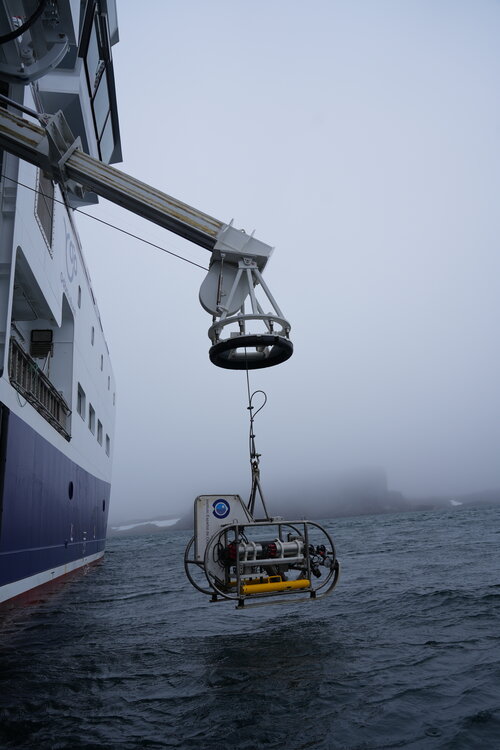
Credit image: IEO-CSIC
Output
The final output of the Working Group will be an EMB Position Paper to be published in 2028.
More information about EMB's output on Ocean observation and research infrastructures is available here.
Background
Ocean research is underpinned by observations and monitoring, which require a wide variety of equipment and an understanding of their capabilities. Many of the EMB Member organisations own and operate such equipment and/or engage in relevant consortia and initiatives. Many of the EMB Member organisations own and operate such equipment and/or engage in relevant consortia and initiatives.
The recent EU Ocean Pact and related OceanEye, the upcoming Ocean Act, and the Ocean and Water Research & Innovation Strategy for Horizon Europe 2028 – 2034 are bringing focus to Europe’s Ocean observation capabilities and the research it supports, both in terms of the current status and required future direction. The OceanEye aims to ensure a fit-for-purpose Ocean observing system and to meaningfully guide investment decisions in the next EU Multiannual Financial Framework (MFF 2028-2034). In addition, these recent European initiatives support the development of a European Research Area (ERA), the EU’s ambition to create a single, borderless market for research, innovation and technology across the EU.
While significant knowledge and expertise already exist, this information is scattered and mainly organised by networks, technologies and uses. An EMB publication will compile this diverse information to present the in situ Ocean observing equipment used for Ocean research, their capabilities, recent evolution and future needs, and provide strategic direction towards a fit-for-purpose Ocean observing system. This publication would summarize the current European capability in a centralised document and provide a baseline for the new governance of Ocean observing in Europe. This will be invaluable to policymakers, funders and other relevant audiences, helping them understand the current status and capabilities of the Ocean research system, their evolution and future requirements for a fit for purpose Ocean intelligence system.
Working group objectives
The EMB Working Group on "the marine research contribution to the European Ocean observation landscape" will work to present an overview of the current in situ Ocean observation equipment and capabilities used for research, as well as those supported by different national, regional and European initiatives. It will also make an assessment of the future sustainability of their deployment.
This EMB activity will gather into a single document the current in situ equipment available at European research performing organisations, their spatial-temporal capabilities (what they measure and how often), the data flows (from (meta)data collection to where the data go), and the geographical capability, distribution and ownership of this equipment within Europe. It will also highlight if and how the sustained in situ observations programmes are monitored and evaluated. If possible, an indication of how these observations have evolved over the last 5-10 years, and the costs and financial responsibilities for sustaining these observations should be provided.
The document should also provide future research, technology development and policy needs for the implementation of the upcoming Ocean and Water Research and Innovation Strategy (expected by December 2026), to strengthen European-led Ocean research capabilities and the marine knowledge value chain (or Ocean intelligence), and to deliver the objectives of the European Ocean Pact, the OceanEye initiative, and other international commitments. It should build on, and learn from, the 2021 EMB Policy brief on Sustained Ocean Observations and the 2019 EMB Position Paper on Research Vessels, which provided an overview of the role and capabilities of the European research vessel fleet and showed the strategic direction required to ensure that the fleet can continue to support the marine research community in the future.
The selected Working Group should collaborate with relevant initiatives and networks that coordinate or enhance Ocean observation collaboration, via direct interactions and including already available sources. This EMB activity will focus on in situ observation, therefore on natural sciences (physics, biogeochemistry, biology and geology/geophysics). Some acknowledgement of data issues and needs (e.g. interoperability and integration) and remote sensing can be included, but these would not be the focus of the document.
The Terms of Reference of the EMB Working Group is available here.
Meetings
- No meeting has taken place yet.
Working Group Members
To be communicated.
EMB's contribution to Ocean observing
There is a growing recognition of the need to build a comprehensive, end-to-end European Ocean Observing System (EOOS) to coordinate the currently fragmented and complex Ocean observing capacity across Europe. While efforts have been made in the past to overcome fragmentation, limited coordination, weak alignment and insufficient long-term sustainability, the launch of European Commission Ocean monitoring and observation initiative OceanEye is a timely response to help addressing these long-standing structural challenges in European Ocean governance and Ocean observation. With its aim to make Europe leader in global Ocean observation by 2035 and to launch an international alliance to support the Global Ocean Observing System (GOOS), OceanEye will enhance the EU governance to improve the way we collect, share and use ocean data in the EU.
Since 2014 EMB has been an active promoter for the development of a Framework for an European Ocean Observing System (EOOS) to align, integrate and promote Europe's Ocean observing capacity. This is in collaboration with EuroGOOS, EMODnet, Copernicus Marine Service (CMEMS), Marine Research Infrastructures, MBON, JPI Oceans, and many others.
Within this Framework, EMB has provided to European Union consultations (Marine Knowledge 2020, feedback to inception impact assessment on Ocean Observation, Ocean observation – sharing responsibility), engaged in direct interaction with policy makers (incl. DG MARE and RTD) and sent letters to the European Commissioners to highlight the importance of coordinated and sustainable European Ocean observation.
Additionally, through its pan-European network, the European Marine Board provides expert advice from the European marine scientific community in the areas of Ocean observation and Marine Research Infrastructures (MRIs) to inform marine research policy and strategic planning. EMB activities to date include publication of foresight papers (e.g. Position Papers, incl. its recent Navigating the Future VI publication, Future Science Briefs, Policy Briefs), policy statements (e.g. EurOCEAN Declarations, responses to EC consultations), and an active role in European Ocean observation projects (e.g. H2020 AtlantOS and Eurosea, and in the EMODnet Phase III). Core EMB activities related to EOOS includes the Working Groups on Strengthening Europe's biological ocean observing capability and on Sustaining in situ Ocean Observations in the Age of the Digital Ocean, and the new Working Group on "The marine research contribution to the European ocean observation landscape".
Contact at European Marine Board Secretariat: Ángel E. Muñiz Piniella Email