


Being part of the European Marine Board (EMB) Young Ambassadors Programme offers a unique opportunity to grow professionally at the interface between marine science and policy. Opportunities range from organising events and engaging with the Early Career Ocean Professionals (ECOP) community to contributing to EMB working groups, as well as receiving support to attend conferences and specialised training activities. For me, joining the EMB coincided almost perfectly with the beginning of my PhD. My research focuses on the interactions between marine viruses and planktonic organisms, and on how these relationships are shaped by the trophic and oceanographic conditions of the marine environment. Put simply, I aim to identify which microscopic organisms inhabit the water column, which viruses may be infecting them, and how factors such as nutrient availability and environmental conditions influence these interactions.
Viruses are the most abundant biological entities on Earth, with an estimated 1031 viral particles globally and approximately 107 viral particles per millilitre of seawater (Suttle et al., 2005). Despite their remarkable abundance, the vast majority of marine viral diversity remains uncharacterized. When most people think about viruses, they tend to associate them with diseases such as HIV or COVID-19. However, they do not just affect humans and their role in nature is not exclusively negative. For example, in aquatic ecosystems viruses that infect plankton like bacteria, microalgae or other protozoa break down their cells to release organic matter and nutrients into the surrounding environment, making them available for reuse by other microorganisms. This process, known as the viral shunt, alters the way carbon and nutrients circulate through the ocean and makes viruses key players in global biogeochemical cycles.
During infection, some viruses are also capable of temporarily reprogramming the metabolism of the cells they infect. For example, the viruses that infect cyanobacteria, which are major contributors to ocean oxygen production, can sustain or event enhance photosynthesis within the infected cells to support the production of more viral particles. This actively impacts natural marine processes and ecosystem productivity. Understanding when and how these interactions occur, and the mechanisms that regulate them, is therefore essential to improving our understanding of how marine ecosystems function.
In my view, answering these questions requires the use of molecular methodologies capable of identifying marine organisms and viruses, detecting potential interactions between them, and inferring the metabolic processes involved. In this context, bioinformatics is an important tool for transforming vast quantities of data generated by high-throughput sequencing technologies into ecological knowledge.
To strengthen my doctoral training in this field, I applied to attend the Viral Bioinformatics Course organised by the Centre for Virus Research (CVR) at the University of Glasgow. Thanks to support from EMB, I had the opportunity to participate in the ninth edition of the course, held from 15–19 June 2026. Participants came from across Europe and Asia and represented a wide variety of research backgrounds within virology, particularly in areas related to the identification and characterisation of viral pathogens affecting humans, animals, plants and even parasites. Although I was the only participant working specifically in marine viral ecology, I found that the multidisciplinary nature of the course offered valuable exchanges of knowledge and allowed the content to be adapted to our diverse needs.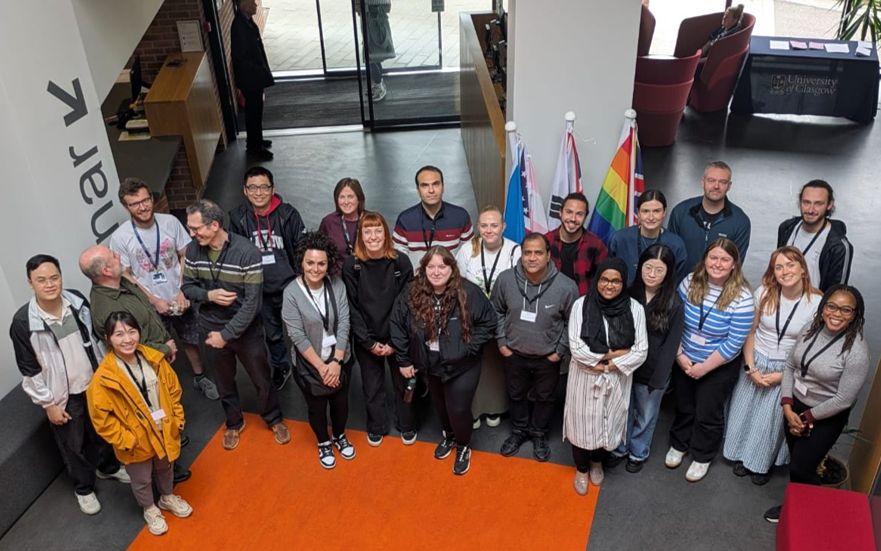
Photo 1. Participants in the 9th Viral Bioinformatics Course organised by the Centre for Virus Research (CVR), University of Glasgow.
The training covered the major stages of bioinformatic analysis of metagenomic sequencing data. The programme began with an introduction to Linux environments and command-line workflows, providing the foundations required to manage large biological datasets through remote high-performance computing systems. This was followed by modules on sequence quality control and pre-processing, as well as alignment, coverage analysis and variant detection, all of which are fundamental for identifying specific viruses within samples.
One of the most relevant sections for my research was focused on the assembly of sequences from metagenomic samples and the identification of those that appear to be viral without the need for prior references. These approaches enable the discovery of previously unknown viruses and hence will be very valuable for exploring ocean viral diversity. The course ended with an introduction to phylogenetic analysis based on multiple sequence alignments, demonstrating how evolutionary relationships among viruses can be reconstructed and how newly identified sequences can be placed within a broader evolutionary context. These approaches can be used for understanding viral evolution, tracking the emergence of new variants and investigating patterns of viral dispersal across regions.
In my case, to achieve the objectives of my PhD thesis, the methods learned for viral sequence assembly and subsequent phylogenetic analysis will be highly valuable for investigating viral–host interactions in marine ecosystems. These approaches will allow me to explore viral genomic evolution and adaptation, particularly using time-series datasets, where monitoring genomic changes in specific viral lineages over time could provide valuable insights into their evolution and their interactions with their hosts.
Beyond the bioinformatics training itself, we had the opportunity to visit the facilities of the Centre for Virus Research and learn about several of its research programmes. We also took part in a practical session on long-read sequencing technologies developed by Oxford Nanopore Technologies, working with portable devices capable of producing genomic data in real time. These technologies are portable and easy to deploy and so could interesting marine research, including during oceanographic expeditions or in remote locations. 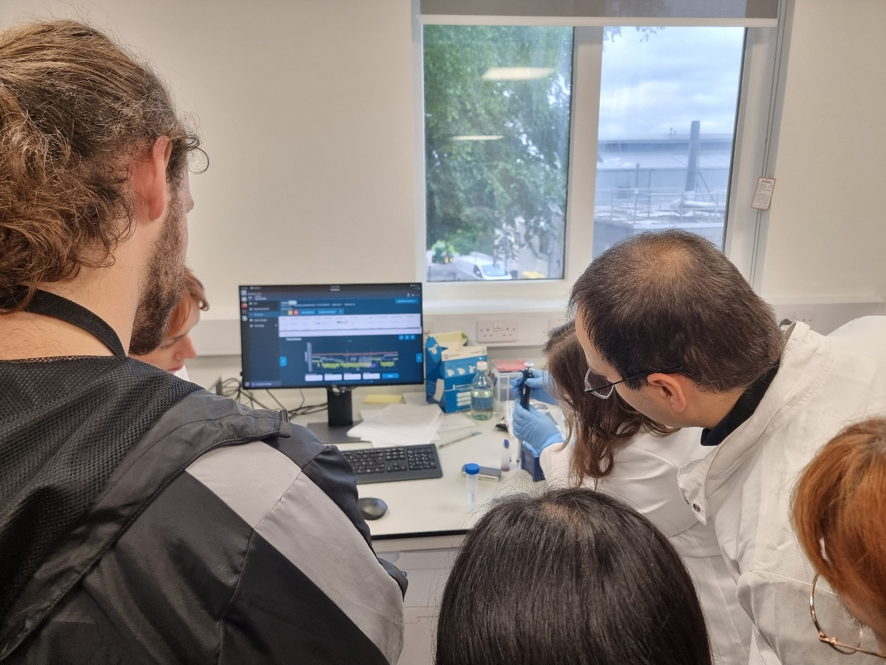
Photo 2. Hands-on training in Oxford Nanopore sequencing, with course participants observing the loading of a flow cell before real-time genomic data acquisition.
For my research, it would be very valuable to have access to this type of technology. In addition to its portability and rapid data generation, long-read sequencing provides much longer reads than Illumina sequencing, which is currently the standard approach for many metagenomic studies like mine. The use of shorter reads can make the assembly of microbial genomes more challenging, particularly in the presence of repetitive or highly similar regions, and may result in fragmented or potentially misassembled genomes. Nevertheless, access to this technology is still relatively limited, as the methodology and workflows are less standardized and sequencing costs can be higher than those of short-read approaches.
My experience in Glasgow was especially meaningful because it directly complements another activity I have been involved in as a Young Ambassador. Recently, I have had the opportunity to contribute to the EMB Working Group on Biomolecular Approaches, which is developing a reference document on the application of biomolecular tools for marine research and monitoring. This document reviews the current state of molecular techniques such as environmental DNA, proteomics and other emerging biomolecular approaches, assessing their applications, strengths and limitations. It also provides recommendations for European policymakers and environmental managers aimed at facilitating the integration of these technologies into monitoring and assessment frameworks. Within this working group, my primary contribution has focused on the chapter dedicated to Capacity Building and Ocean Literacy, which addresses the training and skills required to successfully implement these technologies. From this perspective, experiences such as the Viral Bioinformatics Course clearly demonstrated to me the importance of investing in specialised training to ensure that researchers, technicians and environmental managers possess the expertise needed to apply these approaches effectively.
Equally important is the role of organisations such as the EMB in enabling access to both of these opportunities. Supporting the participation of early-career researchers in specialised training programmes not only strengthens individual skillsets, but also contributes to expanding the knowledge base and uptake of biomolecular technologies across the European marine community. However, funding remains scarce and it would not have been possible for me to attend the course without EMB’s support. Equally, it can be difficult for early-career researchers to gain access to science-policy activities such as the working group without help. My role as Young Ambassadors has enabled both, and my PhD work will also benefit.
As marine science increasingly embraces omics technologies, high-throughput sequencing and large-scale data analysis, I believe that investing in training and providing opportunities means investing in Europe's future capacity to understand, monitor and sustainably manage its seas and ocean.
Reference:
Suttle, C. Viruses in the sea. Nature 437, 356–361 (2005). https://doi.org/10.1038/nature04160
AI Disclaimer:
Copilot was used to improve the structure and clarity of the text.